Adaptive Model-Predictive Control of a Soft Continuum Robot Using a Physics-Informed Neural Network Based on Cosserat Rod Theory
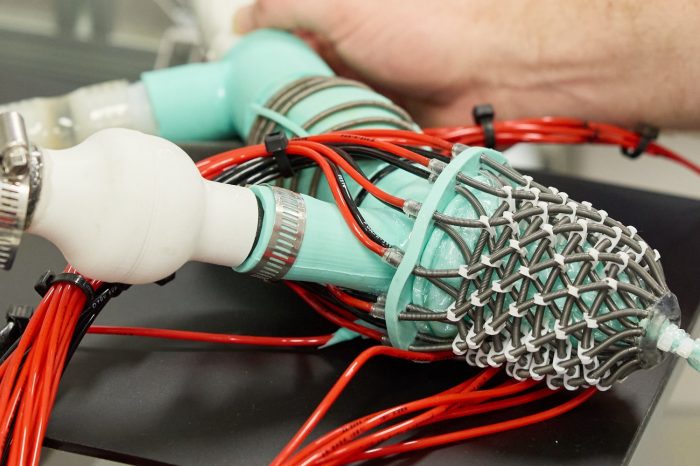
arXiv:2508.12681v3 Announce Type: replace Abstract: Dynamic control of soft continuum robots (SCRs) holds great potential for expanding their applications, but remains a challenging problem due to the high computational demands of accurate dynamic models. While data-driven approaches like Koopman-operator-based methods have been proposed, they typically lack adaptability and cannot reconstruct the full robot shape, limiting their applicability. This work introduces a real-time-capable nonlinear
Overview
arXiv:2508.12681v3 Announce Type: replace Abstract: Dynamic control of soft continuum robots (SCRs) holds great potential for expanding their applications, but remains a challenging problem due to the high computational demands of accurate dynamic models. While data-driven approaches like Koopman-operator-based methods have been proposed, they typically lack adaptability and cannot reconstruct the full robot shape, limiting their applicability. This work introduces a real-time-capable nonlinear model-predictive control (MPC) framework for SCRs based on a domain-decoupled physics-informed neural network (DD-PINN) with adaptable bending stiffness. The DD-PINN serves as a surrogate for the dynamic Cosserat rod model with a speed-up factor of up to 44,000. It is also used within an unscented Kalman filter for estimating the model states and bending compliance from end-effector position measurements. We implement a nonlinear evolutionary MPC running at 70 Hz on the GPU. In simulation, it demonstrates accurate tracking of dynamic trajectories and setpoint control with end-effector position errors below 3 mm (2.3\% of the actuator's length). In real-world experiments, the controller achieves similar accuracy and accelerations up to 3.55 m/s2.
Source
Originally published at arxiv.org.
Related Articles
Source: https://arxiv.org/abs/2508.12681