Bayesian Retraction Optimization for Tissue Attachment Mapping in Surgical Dissection
arXiv:2607.19174v1 Announce Type: new Abstract: With growing surgeon shortages, automating surgical sub-tasks such as tissue dissection offers a promising step toward reducing workload and expanding patient access. Prior work has relied on hand-crafted incision policies that cannot quantify uncertainty or has relied on simulation-based methods that require strong modeling assumptions. We instead view tissue attachment identification as an inherently probabilistic problem and propose a Bayesian
Overview
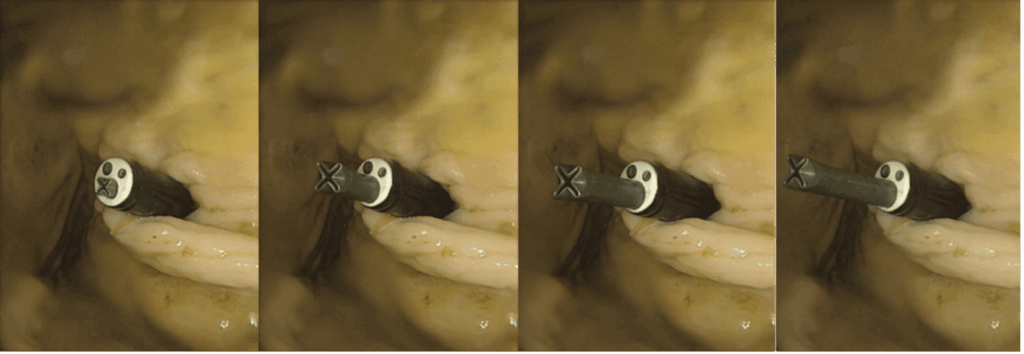
arXiv:2607.19174v1 Announce Type: new Abstract: With growing surgeon shortages, automating surgical sub-tasks such as tissue dissection offers a promising step toward reducing workload and expanding patient access. Prior work has relied on hand-crafted incision policies that cannot quantify uncertainty or has relied on simulation-based methods that require strong modeling assumptions. We instead view tissue attachment identification as an inherently probabilistic problem and propose a Bayesian approach that avoids explicit tissue modeling. Our method uses a Sequential Bayesian Hilbert Map (SBHM) to represent the likelihood that each tissue point is attached to the underlying resection surface. An ensemble of learned classifiers predicts attachment likelihoods from spatial data acquired during robotic tissue retraction, with each classifier serving as a noisy information source to update the SBHM. To plan the next retraction, we devise Bayesian Retraction Optimization (BRO) to select the most informative action under safety constraints. As the SBHM refines over time, regions with high attachment likelihood are selectively incised. We validate our method in simulation across diverse tissue geometries and acquisition strategies, and demonstrate zero-shot transfer to real robotic dissection experiments.
Source
Originally published at arxiv.org.
Related Articles
- RoboInter1.5: A Holistic Intermediate Representation Suite for Embodied World Modeling and Robotic Manipulation
- SKETCH: Semantic Key-Point Conditioning for Long-Horizon Vessel Trajectory Prediction
- STeP: Signal Temporal Logic for Precise Specifications for Action Generation with Vision Language Models
Source: https://arxiv.org/abs/2607.19174