BIEVR-LIO: Robust LiDAR-Inertial Odometry through Bump-Image-Enhanced Voxel Maps
arXiv:2604.14421v2 Announce Type: replace Abstract: Reliable odometry is essential for mobile robots as they increasingly enter more challenging environments, which often contain little information to constrain point cloud registration, resulting in degraded LiDAR-Inertial Odometry (LIO) accuracy or even divergence. To address this, we present BIEVR-LIO, a novel approach designed specifically to exploit subtle variations in the available geometry for improved robustness. We propose a high-resol
Overview
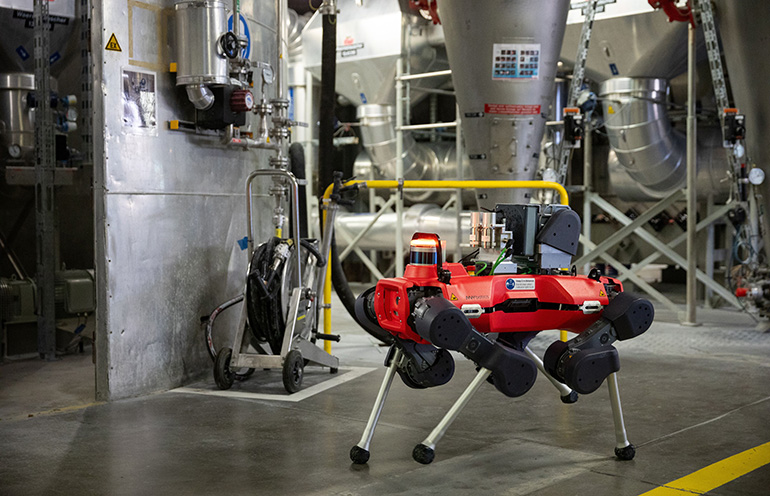
arXiv:2604.14421v2 Announce Type: replace Abstract: Reliable odometry is essential for mobile robots as they increasingly enter more challenging environments, which often contain little information to constrain point cloud registration, resulting in degraded LiDAR-Inertial Odometry (LIO) accuracy or even divergence. To address this, we present BIEVR-LIO, a novel approach designed specifically to exploit subtle variations in the available geometry for improved robustness. We propose a high-resolution map representation that stores surfaces as voxel-wise oriented height images. This representation can directly be used for registration without the calculation of intermediate geometric primitives while still supporting efficient updates. Since informative geometry is often sparsely distributed in the environment, we further propose a map-informed point sampling strategy to focus registration on geometrically informative regions, improving robustness in uninformative environments while reducing computational cost compared to global high-resolution sampling. Experiments across multiple sensors, platforms, and environments demonstrate state-of-the-art performance in well-constrained scenes and substantial improvements in challenging scenarios where baseline methods diverge. Additionally, we demonstrate that the fine-grained geometry captured by BIEVR-LIO can be used for downstream tasks such as elevation mapping for robot locomotion.
Source
Originally published at arxiv.org.
Related Articles
Source: https://arxiv.org/abs/2604.14421