Eversion-based robots can enable safe access,steering and endoscopic imaging within the spinal subarachnoid space
arXiv:2607.19274v1 Announce Type: new Abstract: Safe navigation within the spinal subarachnoid space is constrained by its narrow, compliant, and delicate anatomy. Conventional catheters and continuum robots rely on proximal pushing, generating friction and shear along the tissue device interface that limit distal controllability and increase the risk of neural injury. Here, we present a 2 mm diameter eversion-growing robotic platform that enables friction minimised extension and steering withi
Overview
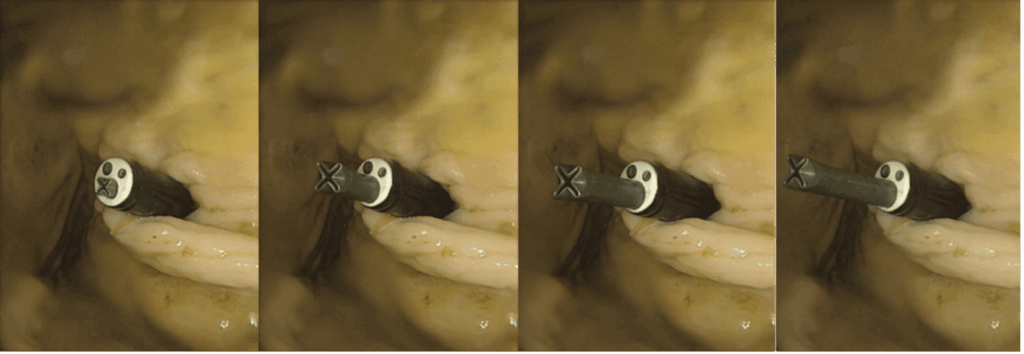
arXiv:2607.19274v1 Announce Type: new Abstract: Safe navigation within the spinal subarachnoid space is constrained by its narrow, compliant, and delicate anatomy. Conventional catheters and continuum robots rely on proximal pushing, generating friction and shear along the tissue device interface that limit distal controllability and increase the risk of neural injury. Here, we present a 2 mm diameter eversion-growing robotic platform that enables friction minimised extension and steering within the human spinal subarachnoid space, validated through computational modelling, phantom experiments, and intact human cadaver studies. The robot integrates a miniature endoscope for real time intrathecal visualisation and advances by pressure driven tip eversion, localising motion to the distal tip while minimising translational sliding of the deployed body. Phantom experiments demonstrated reductions of 65.2% in mean interaction force and 48.0% in peak interaction force compared with matched push-based insertion. Physics based modelling showed that eversion based growth redistributed tissue loading, reducing local stress concentrations and interfacial shear relative to conventional insertion. In an intact human cadaver, the system achieved 150 mm of controlled intrathecal extension with concurrent fluoroscopic and endoscopic visualisation, providing access across multiple vertebral levels from a standard lumbar entry point. Postprocedural laminectomy and durotomy revealed no observable macroscopic disruption of the dura mater or surrounding neural structures. These results provide the first mechanically characterised and multimodally validated demonstration of eversion-based robotic navigation in intact human spinal anatomy, establishing a quantitative and procedural foundation for future intrathecal interventions. Further validation in larger anatomical cohorts and under physiological conditions will be required before clinical translation.
Source
Originally published at arxiv.org.
Related Articles
- RoboInter1.5: A Holistic Intermediate Representation Suite for Embodied World Modeling and Robotic Manipulation
- SKETCH: Semantic Key-Point Conditioning for Long-Horizon Vessel Trajectory Prediction
- STeP: Signal Temporal Logic for Precise Specifications for Action Generation with Vision Language Models
Source: https://arxiv.org/abs/2607.19274