Learning Fault-Tolerant Locomotion with Adaptive Gait Timing
arXiv:2608.07328v1 Announce Type: new Abstract: Hardware failures require legged robots to rapidly reorganize coordination and gait timing to maintain stability and mobility. This is particularly challenging for larger quadrupeds, where increased mass and tighter actuation limits reduce the feasibility of aggressive, high-frequency compensation strategies often observed on smaller platforms. In this work, we propose a deep reinforcement learning approach for fault-tolerant locomotion under actu
Overview
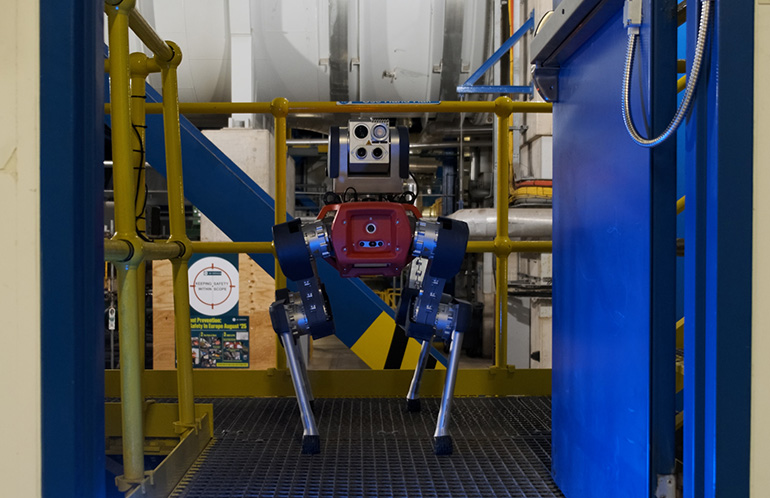
arXiv:2608.07328v1 Announce Type: new Abstract: Hardware failures require legged robots to rapidly reorganize coordination and gait timing to maintain stability and mobility. This is particularly challenging for larger quadrupeds, where increased mass and tighter actuation limits reduce the feasibility of aggressive, high-frequency compensation strategies often observed on smaller platforms. In this work, we propose a deep reinforcement learning approach for fault-tolerant locomotion under actuator power loss. The method employs an asymmetric actor-critic architecture in which the critic has access to privileged information during training, while the actor learns to reconstruct a corresponding latent representation from proprioceptive observations. We introduce a latent-alignment loss that encourages consistency between actor and critic representations. Additionally, we augment the action space with a learnable gait frequency parameter, enabling adaptive gait timing in response to terrain variations and actuator degradation without predefined faulty-leg strategies. The approach is validated in high-fidelity simulation on uneven terrain and real-world experiments on flat ground using a 68 kg quadruped robot.
Source
Originally published at arxiv.org.
Related Articles
Source: https://arxiv.org/abs/2608.07328