Model-based Optimization of Anguilliform Swimming Gaits for Soft Robotic Applications
arXiv:2606.11278v1 Announce Type: new Abstract: In this paper, we introduce the Soft Lamprey-Inspired Dual Environment Robot (SLIDER) and a proper modeling and optimization procedure employed to design the robot. We represent the primary fluid environment actions - inertial effects, vortex forces, and viscous dissipation - using Lighthill's theory for large-amplitude elongated bodies. For structural design parameters such as internal pressure, tail size, and body stiffness, a fast, geometricall
Overview
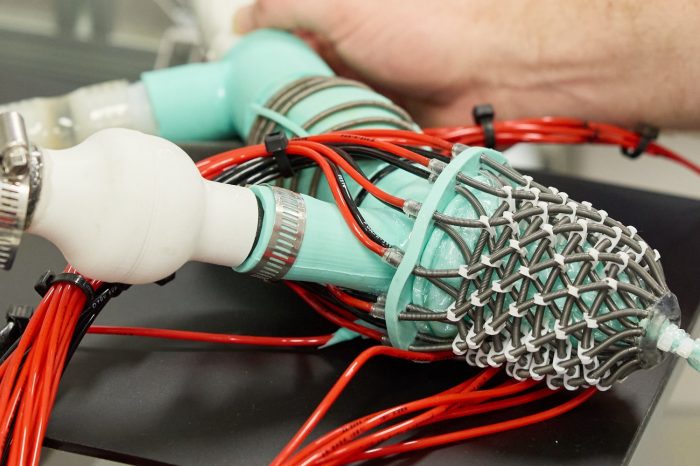
arXiv:2606.11278v1 Announce Type: new Abstract: In this paper, we introduce the Soft Lamprey-Inspired Dual Environment Robot (SLIDER) and a proper modeling and optimization procedure employed to design the robot. We represent the primary fluid environment actions - inertial effects, vortex forces, and viscous dissipation - using Lighthill's theory for large-amplitude elongated bodies. For structural design parameters such as internal pressure, tail size, and body stiffness, a fast, geometrically and materially nonlinear model is developed and validated. The fluid-structure interaction equations are solved implicitly with an efficient second-order box method. A pneumatic manifold robotic system is employed to actuate SLIDER in a quiescent water tank environment, allowing cross-comparison of computational and experimental results. We find that low-frequency swimming is dominated by resistant environmental forces, whereas higher-frequency swimming is primarily affected by inertial fluid forces. Using our efficient model alongside a genetic algorithm, we co-optimize a swimming control pattern and caudal fin design (subject to SLIDER's climbing morphology) to achieve a tethered swimming speed of 21.7 +/- 0.4 cm/s (0.59 Bl/s). Furthermore, we investigate the optimization procedure for a multimodal robot performing both swimming and climbing tasks.
Source
Originally published at arxiv.org.
Related Articles
Source: https://arxiv.org/abs/2606.11278