MVP-Tac: A Miniaturized Dual-Modal Vision and Photoelastic Tactile Sensor for Robot-Assisted Minimally Invasive Surgery
arXiv:2607.18660v1 Announce Type: new Abstract: Robot-assisted minimally invasive surgery (RMIS) offers major benefits over open and conventional laparoscopic procedures, yet it still lacks tactile feedback for palpation while operating under strict requirements to preserve reliable vision for navigation and safety. In practice, visual feedback is indispensable, and tactile solutions that cannot coexist with vision are difficult to translate into RMIS tools. To address both needs, we introduce
Overview
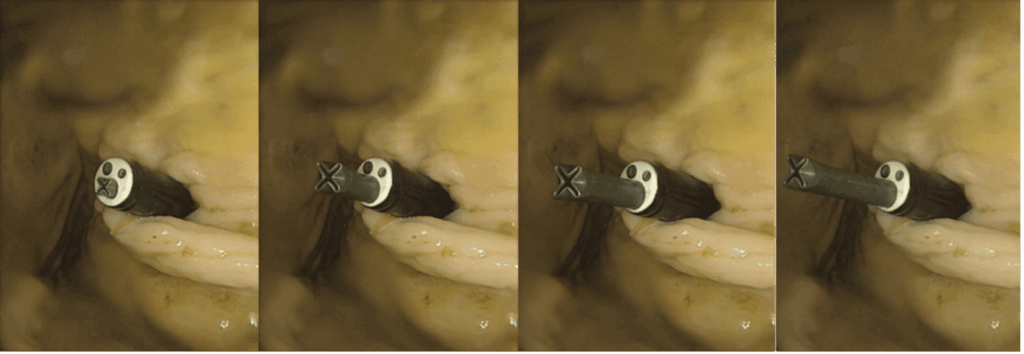
arXiv:2607.18660v1 Announce Type: new Abstract: Robot-assisted minimally invasive surgery (RMIS) offers major benefits over open and conventional laparoscopic procedures, yet it still lacks tactile feedback for palpation while operating under strict requirements to preserve reliable vision for navigation and safety. In practice, visual feedback is indispensable, and tactile solutions that cannot coexist with vision are difficult to translate into RMIS tools. To address both needs, we introduce MVP-Tac, a compact, vision-based tactile sensor that provides co-located vision and tactile sensing. MVP-Tac uses reflective photoelastic imaging: a thin photoelastic elastomer produces stress-dependent interferograms under contact that are captured by an embedded camera through a miniaturized reflective polariscope. A semi-transparent membrane and controllable illumination enable switching between visual mode and tactile mode, enabling tactile perception without sacrificing vision. We validate MVP-Tac through force calibration in the 0 to 2 N range and demonstrate its potential for tumor palpation via video-based hardness classification on tissue phantoms, achieving 97% accuracy for exposed-tumor classification and 92% accuracy for subdermal-tumor classification. Finally, we conduct a simulated colonoscopy to validate both visual and tactile modalities in a constrained lumen, including vision-guided 3D photomapping of the luminal wall and in situ hardness classification of localized nodules. Overall, MVP-Tac provides a practical path toward restoring clinically useful palpation in RMIS while maintaining essential visual feedback. The design, fabrication, and firmware of MVP-Tac are open-sourced at https://mvp-tac.github.io/
Source
Originally published at arxiv.org.
Related Articles
- RoboInter1.5: A Holistic Intermediate Representation Suite for Embodied World Modeling and Robotic Manipulation
- SKETCH: Semantic Key-Point Conditioning for Long-Horizon Vessel Trajectory Prediction
- STeP: Signal Temporal Logic for Precise Specifications for Action Generation with Vision Language Models
Source: https://arxiv.org/abs/2607.18660