PROBE: Manipulation-Grounded Visual Question Answering with VLM Agents
arXiv:2608.17129v1 Announce Type: cross Abstract: Vision-language Models (VLMs) excel at 2D grounding, spatial reasoning and agentic tool-based planning in static scenes. However, consider asking a home robot "Is my medication still in the cabinet?" The answer may be physically hidden behind a row of containers that must first be moved aside. Answering such questions in real-world cluttered environments requires reasoning in dynamic scenes: distractors must be manipulated to reveal occluded obj
Overview
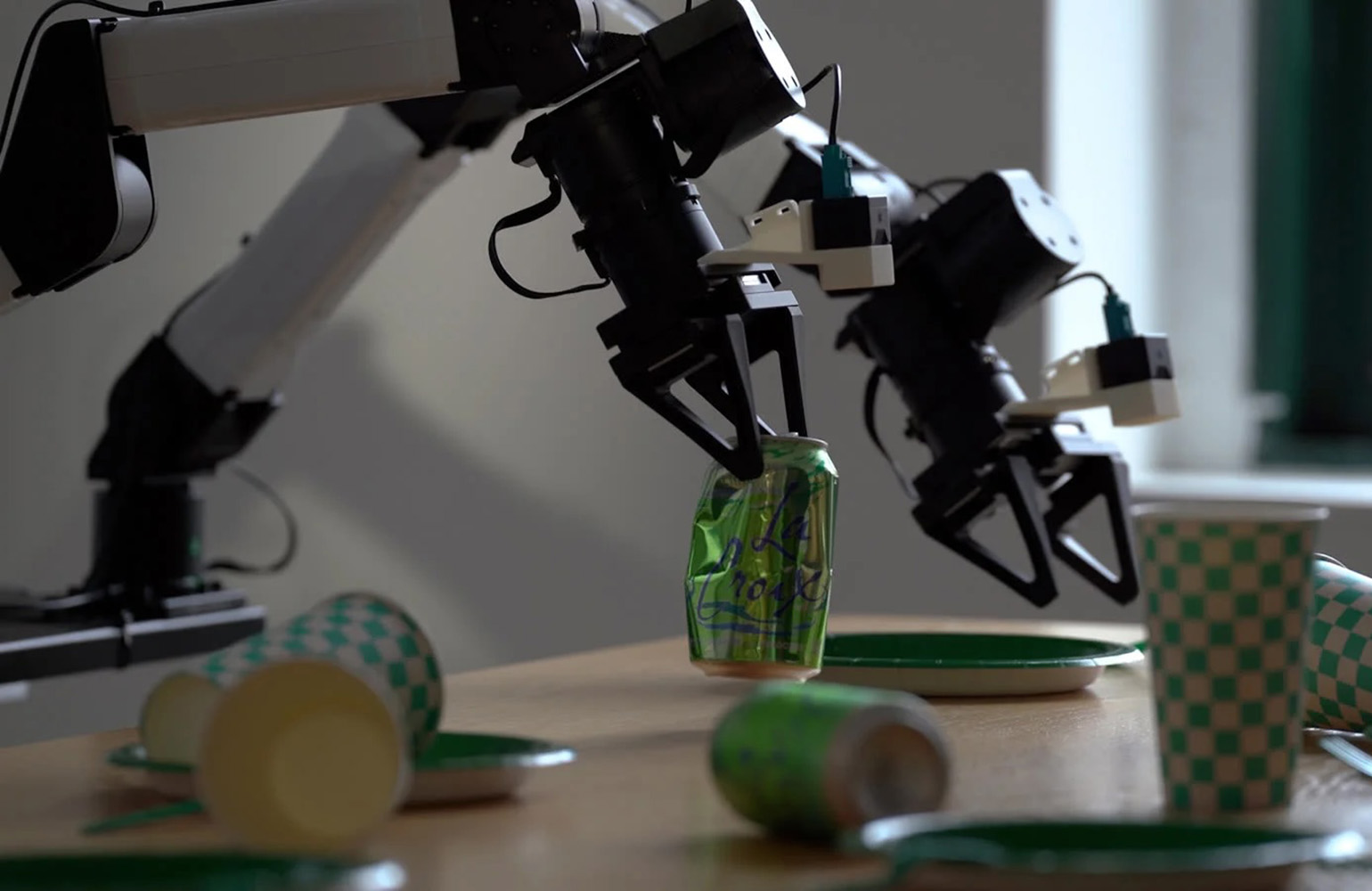
arXiv:2608.17129v1 Announce Type: cross Abstract: Vision-language Models (VLMs) excel at 2D grounding, spatial reasoning and agentic tool-based planning in static scenes. However, consider asking a home robot "Is my medication still in the cabinet?" The answer may be physically hidden behind a row of containers that must first be moved aside. Answering such questions in real-world cluttered environments requires reasoning in dynamic scenes: distractors must be manipulated to reveal occluded objects, and each action changes the scene the model must reason over. We formalize this setting as Manipulation-Grounded Visual Question Answering (MG-VQA) and introduce PROBE, a framework for benchmarking and finetuning VLM agents on such tasks. We first develop PROBE-Sim, a high-fidelity tabletop simulator with everyday objects and a robot manipulator equipped with grasping and pushing tools. PROBE-Sim is used to create PROBE-Bench: an evaluation suite of 150 tasks across 6 question types on cluttered tabletop scenes, where a VLM perceives, picks up or pushes objects before answering. We observe consistent trend across all frontier VLMs: agentic tool-based methods outperform their perception-only baselines (8.0% on average) across all task types. We further design PROBE-Agent, a finetuning recipe to distill successful trajectories from a powerful teacher foundation model to a smaller open-weight model using a mixed data recipe that encourages manipulation-efficient question answering. PROBE Agent finetuned models outperform their off-the-shelf agent baseline (11.5% on average) and demonstrate positive transfer to unseen objects and a held-out task. We validate sim-to-real transfer by deploying PROBE-Agent finetuned policies in real-world tabletop environments.
Source
Originally published at arxiv.org.
Related Articles
Source: https://arxiv.org/abs/2608.17129