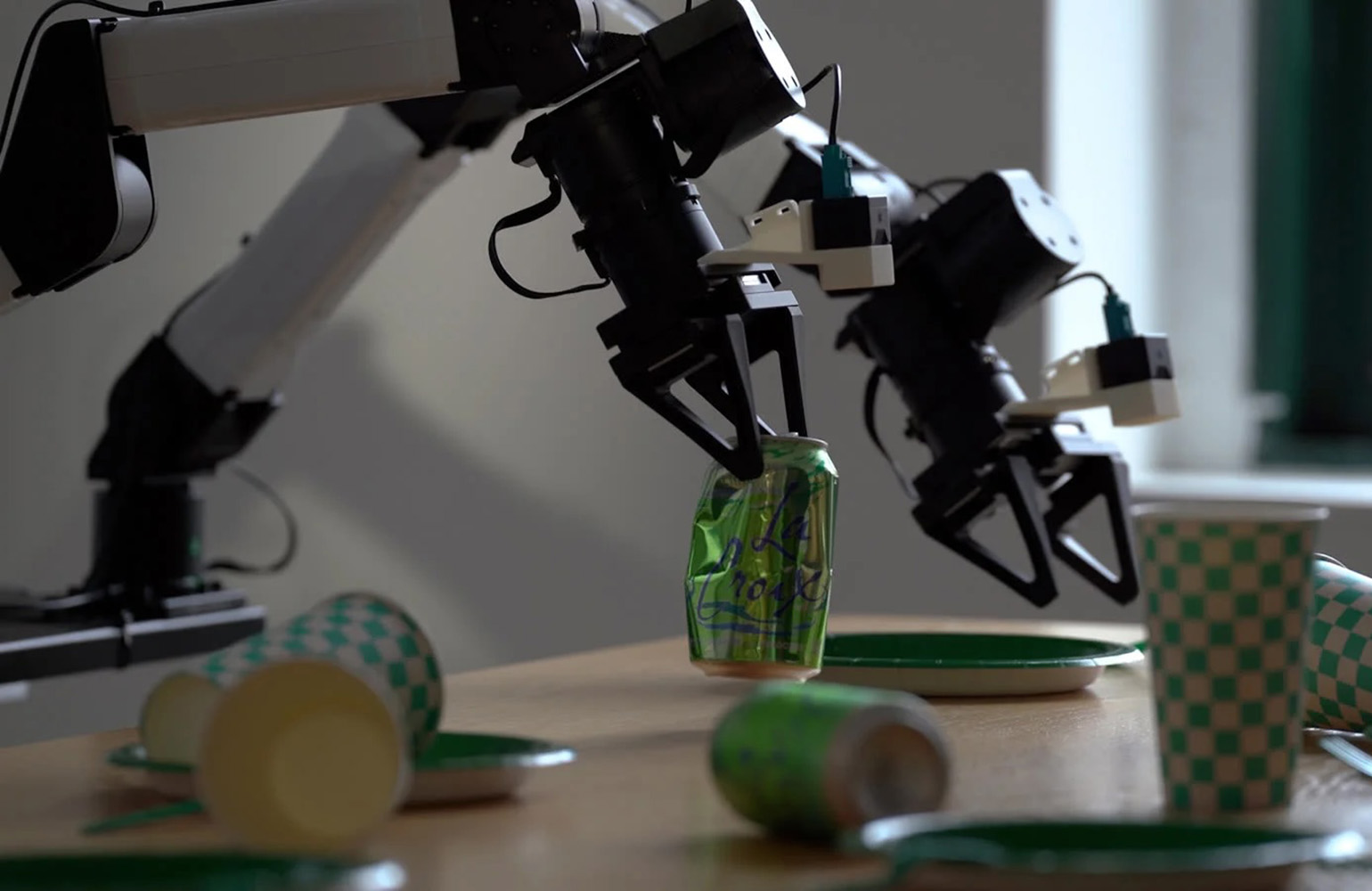
SoftVTBench: A Deformation-Aware Visuo-Tactile Dataset and Benchmark for Deformable-Object Manipulation
arXiv:2608.18701v1 Announce Type: new Abstract: Physical interaction quality is central to deformable-object manipulation, yet most benchmarks evaluate task success alone. A policy may complete the task while allowing slip or causing excessive compression. A primary bottleneck is the absence of visuo-tactile datasets that pair policy-visible contact observations with independent physical ground truth over complete tasks. We introduce SoftVTBench, a visuo-tactile dataset for physical-interaction
Overview
arXiv:2608.18701v1 Announce Type: new Abstract: Physical interaction quality is central to deformable-object manipulation, yet most benchmarks evaluate task success alone. A policy may complete the task while allowing slip or causing excessive compression. A primary bottleneck is the absence of visuo-tactile datasets that pair policy-visible contact observations with independent physical ground truth over complete tasks. We introduce SoftVTBench, a visuo-tactile dataset for physical-interaction-aware deformable-object manipulation. It contains 4,000 expert demonstrations and more than 50 assets, including volumetric deformable objects and visually matched rigid twins. At 20 Hz, each episode synchronizes multi-view RGB, dual-finger tactile RGB and marker motion, proprioception, language, and binary and continuous gripper actions, alongside evaluator-only finite-element (FEM) states. Building upon this dataset, we establish a closed-loop benchmark that uses fixed object-specific calibration to define the Deformation-aware Success Rate (DSR), which counts a rollout as successful only when it completes the task and keeps peak normalized deformation within tolerance. Across Diffusion Policy, $\pi_{0.5}$, and FastWAM, all 12 in-distribution configurations contain successful rollouts that violate the deformation tolerance, accounting for 0.7--24% of each configuration's successes. Under distribution shift, visuo-tactile variants achieve higher task success in all six policy--suite comparisons and higher DSR in five, whereas their in-distribution benefits are mixed. These results show that making touch available does not by itself ensure effective multimodal fusion. SoftVTBench therefore provides a common visuo-tactile resource for studying not only whether a policy succeeds, but how it physically interacts with deformable objects and when touch improves that interaction.
Source
Originally published at arxiv.org.
Related Articles
- Scheduling and Routing with Degradation-Triggered Job Arrivals: An Application to Forest Firefighting with an Unmanned Aerial Vehicle Fleet
- GAPL: Grounded Action-effect Policy Learning for LLM-Based Trajectory Planning
- Transferable Tool-Tissue Contact Detection from Stereo Depth in Robot-Assisted Surgery
Source: https://arxiv.org/abs/2608.18701