Sonair ADAR One 3D ultrasonic sensor is now safety-certified
Sonair says ADAR One was assessed as a human detection sensor according to the IEC 61496 standard for electrosensitive protection devices. The post Sonair ADAR One 3D ultrasonic sensor is now safety-certified appeared first on The Robot Report.
Overview
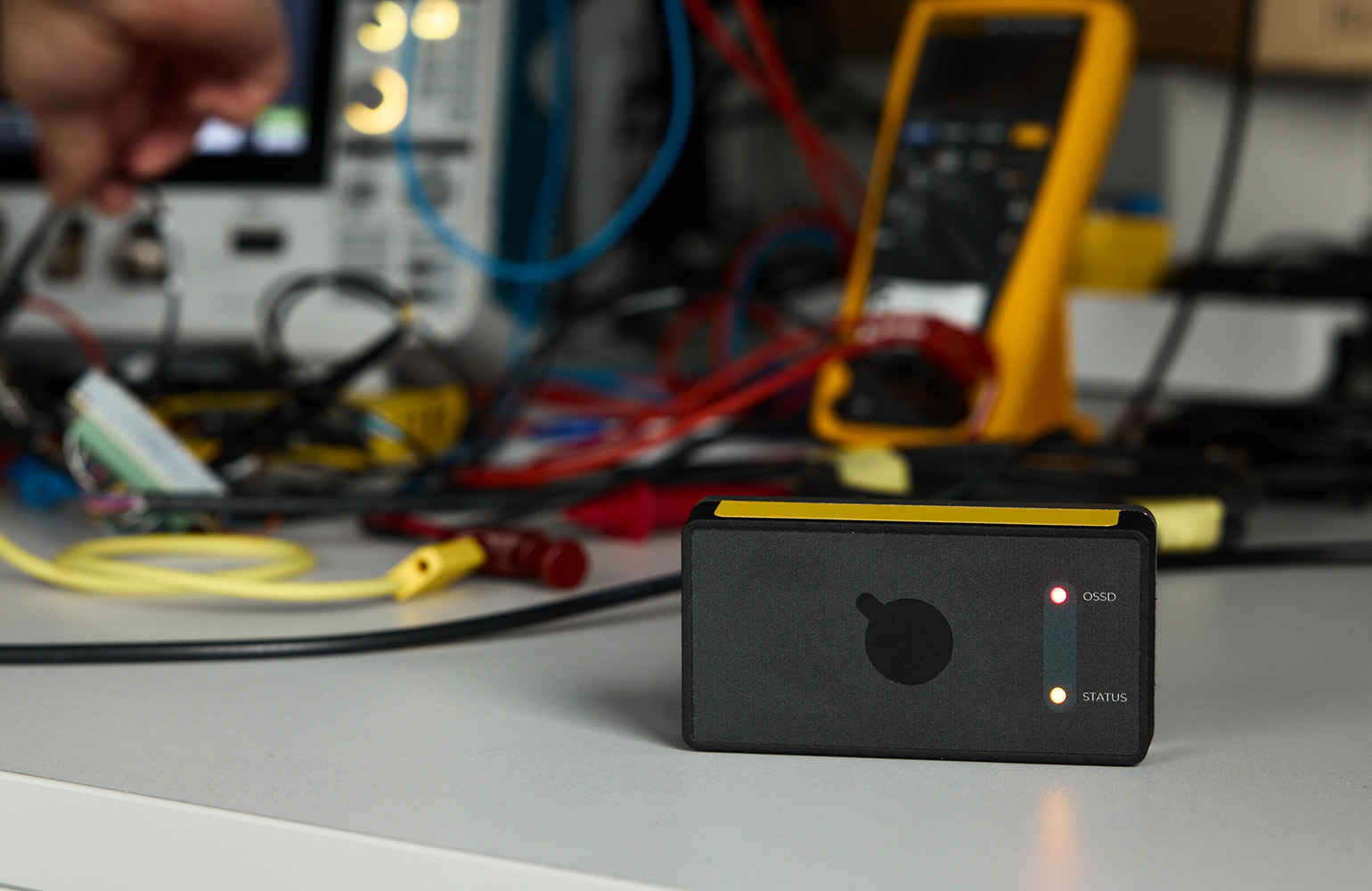
A small footprint enables ADAR technology to be embedded flush into virtually any robot form factor, Sonair said. | Source: Sonair
Sonair today said that its ADAR One sensor is now suitable for SIL2 and PL d applications and is certified to fulfil all requirements of the European Machinery Directive as an acoustic detection and ranging sensor for the safe detection of humans and objects.
ADAR One was assessed as a human protection sensor according to the demanding IEC 61496 standard for electrosensitive protection devices. The sensor also meets two foundational standards: IEC 61508, the functional safety standard for electronic safety systems in high-risk industrial environments, and ISO 13849, the universal standard for safety-related parts of control systems.
“It is hard to convey how extensive and all-encompassing a safety certification process is,” Knut
Sandven, CEO of Sonair, told The Robot Report. “We paused all other development for a long stretch and literally spent nights, weekends, and holidays getting it done. We certified ADAR to Performance Level d under ISO 13849 and SIL2 under IEC 61508, with exida in Germany as the assessing body.”
Safety infrastructure lagged AI advancements, says Sonair
Recent advances in AI have created robots that are smarter and more capable. However, the accompanying safety infrastructure has struggled to keep pace. Traditional 2D laser scanners, which are widely used to define safety perimeters for many mobile robots, are unable to detect people and obstacles above or below a single plane.
“Navigation in 2D can be perfectly fine. A robot can localize, map, and plan a route from a horizontal scan. Safety in 2D is a different matter,” Sandven said. “A 2D safety scanner sees the world as a single horizontal slice, usually around leg height. It catches a person’s legs but misses anything that does not cross that one plane: a person leaning in toward the robot, an overhanging shelf, or something suspended from the ceiling. To account for that, integrators compensate with large safety margins and low speeds, which costs throughput.”
Designed for autonomous mobile robots (AMRs) and industrial automation, ADAR One delivers 180°×180° 3D spatial awareness, detecting people and obstacles at all heights, said the Oslo-based company.
“The point is not that 2D is useless. It is the current default for protecting people, and it does that job,” Sandven said. “But it is not the best tool for confirming that a person is clear of harm across the full working space of a robot.”
What is the certification process like?
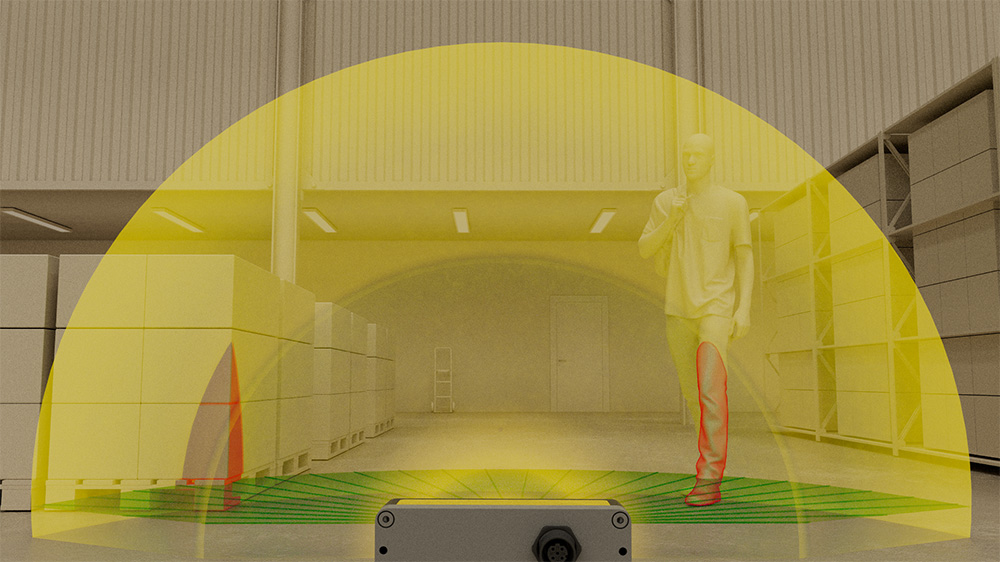
Robotics developers can deploy ADAR One in AMRs, AGVs, and cobot architectures without seeking special exemptions. | Source: Sonair
ADAR is rated SIL 2 (Safety Integrity Level 2) and PL d (Performance Level d) with a probability of dangerous failure (PFH) below 1.5 x 10^-7 per hour. ADAR has received an ECCE type-examination certificate from exida, a notified body under the Machinery Directive 2006/42/EC.
“To reach PLd and SIL2, you have to prove that the probability of dangerous failure per hour is inside the required band, and demonstrate the diagnostic coverage and architecture to support it, which means the design has to detect its own faults and move to a safe state when it can no longer trust its own measurement,” Sandven said. “The part people underestimate is everything around the numbers or metrics: the development process evidence, the failure mode analysis, the documentation, and the validation testing the assessor reviews.”
“The hardware metric is necessary, but it is the systematic rigor across the whole lifecycle that actually earns the certificate,” he added. “The final documentation package for the assessors runs to many thousands of pages.”
Sonair breaks new ground for ultrasonic sensors
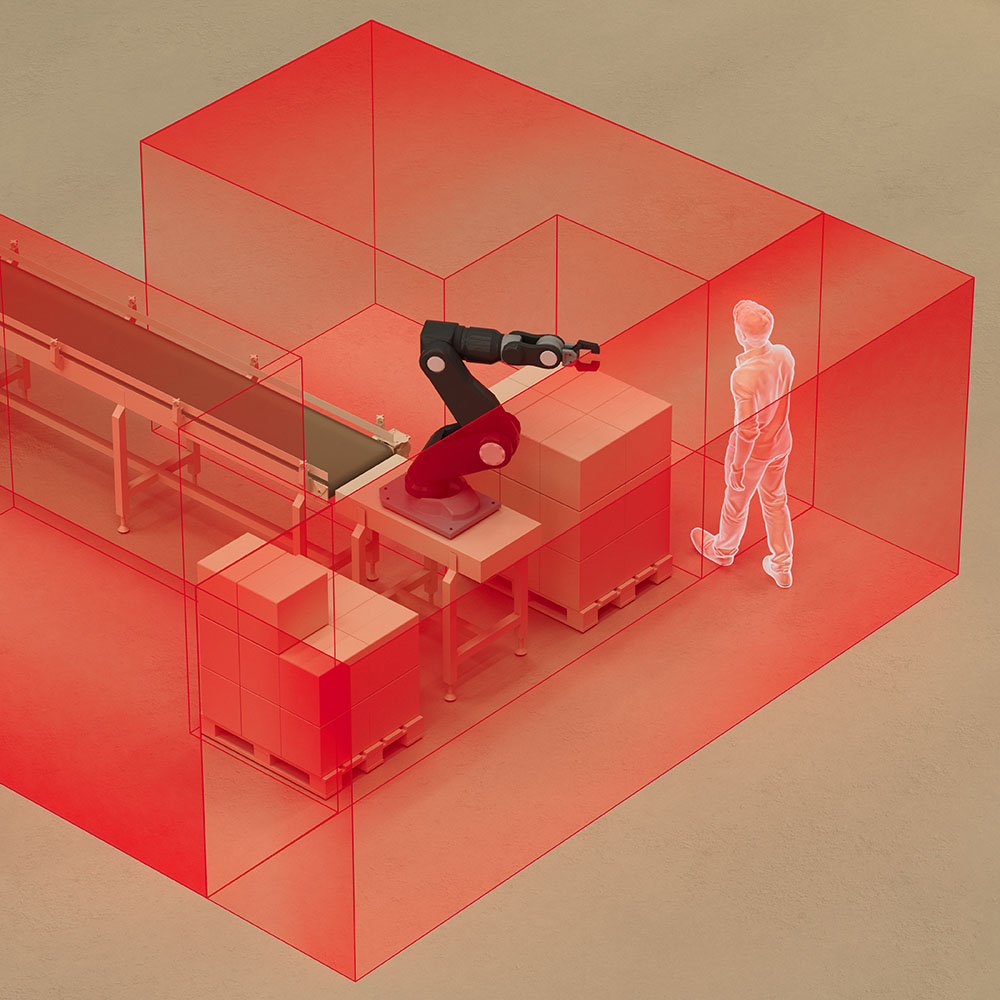
Sonair says ADAR One improves productivity, increases uptime, reduces incidents, and inspires trust. | Source: Sonair
Sonair claimed that ADAR One is the first ultrasonic sensor to comply with the international standards. The standards bodies had to make adjustments to their tests, which were created around optical sensors.
“This was one of the more interesting parts,” Sandven said. “The type standard for this class of protective sensor, IEC 61496, is written around opto-electronic devices like light curtains and laser scanners, so it defines detection capability in optical terms, with physical test pieces of a given diameter that the device must reliably detect. Most of this is not relevant for ultrasound.”
“What an ultrasonic sensor sees depends on the acoustic reflectivity and cross-section of an object, not its optical properties, so the tests for detection capability had to be re-expressed in terms that make sense for sound,” he continued.
Details
“We used the IEC 62998, the more recent standard for safety-related sensors, which is deliberately technology-agnostic and written to accommodate exactly the kind of novel sensing modality that did not exist when the older standards were drafted,” said Sandven. “So it was less the standards bodies rewriting anything and more a case of mapping new physics onto an existing safety framework, defining how you prove detection capability acoustically, and documenting that reasoning so it holds up to assessment.”
Furthermore, ADAR is the first safety-certified embedded system to be built in Rust, a programming language especially designed for performance, safety, and reliability.
What applications and robots could benefit from ADAR One?
Sonair said ADAR One is already in series production and shipping on deployed industrial robots. It can benefit a range of industries and applications, Sandven asserted.
“The clearest fit today is mobile robots operating in spaces shared with people, AMRs in warehouses and manufacturing, and service robots,” he said. “Ultrasound adds even more where the environment is hard on optical sensors: dust, glare, glass surfaces, or poor lighting. And we see strong interest from robot arms of all kinds, where being able to drop the safety fence is valuable.”
ADAR One’s compact form factor allows it to be embedded directly into a humanoid‘s body shell without significant redesign of the underlying structure.
“Humanoids sharpen every problem ADAR was built for. They are tall and move in three dimensions. They are expected to operate close to people, which makes reliable detection of a human in the volume around the machine essential,” Sandven said. “Because the transducer array is extremely small, it can be designed into the body itself and made effectively invisible, which matters for a form factor where appearance and integration are part of the product.
“There is also a more fundamental role here,” he noted. “A humanoid working alongside people has to do more than avoid obstacles. It has to distinguish a person from an object and treat them differently, and a dedicated, certified safety sensor is an obvious part of doing that reliably. Because it perceives by sound, it complements cameras rather than duplicating them, covering the cases where vision degrades.”
ADAR One is now available
ADAR One, the safety-certified variant designed for autonomous robots and machine safety applications requiring SIL 2, PL d compliance, is available now. Sonair also offers an ADAR test kit for engineers evaluating 3D ultrasonic sensing for new or existing safety use cases. Looking ahead, the company said it plans to deploy ADAR One at scale.
“The headline is converting the certification and the early validation into deployments at scale, moving partners from testing into volume, and supporting the first product integrations well,” Sandven said. “Alongside that, we are deepening the partnership side of the business so ADAR reaches the market through the channels that already serve robot builders. And we keep improving, with plenty of ideas for making safety simpler for the teams building robots.”
Eventually, the company also hopes to iterate on the ADAR One.
“We see ADAR as a platform rather than a single product,” Sandven said. “The natural directions for the next generation are refining the form factor further and bringing cost down as volume grows, both of which widen the set of applications it can serve. We are also watching where the market is heading, including humanoids and denser human-robot environments, and listening to what customers tell us they need next, which is the most reliable guide we have.”
 Submit your session idea for the 2026 RoboBusiness
The post Sonair ADAR One 3D ultrasonic sensor is now safety-certified appeared first on The Robot Report.
Source
Originally published at www.therobotreport.com.
Related Articles
Source: https://www.therobotreport.com/sonair-3d-ultrasonic-sensor-is-now-safety-certified/