Strengthening U.S. Army sustainment: TALUS to deliver autonomous distribution
A Stratom-led team won a U.S. Army contract to develop TALUS, an autonomous logistics system for contested environments. The post Strengthening U.S. Army sustainment: TALUS to deliver autonomous distribution appeared first on The Robot Report.
Overview
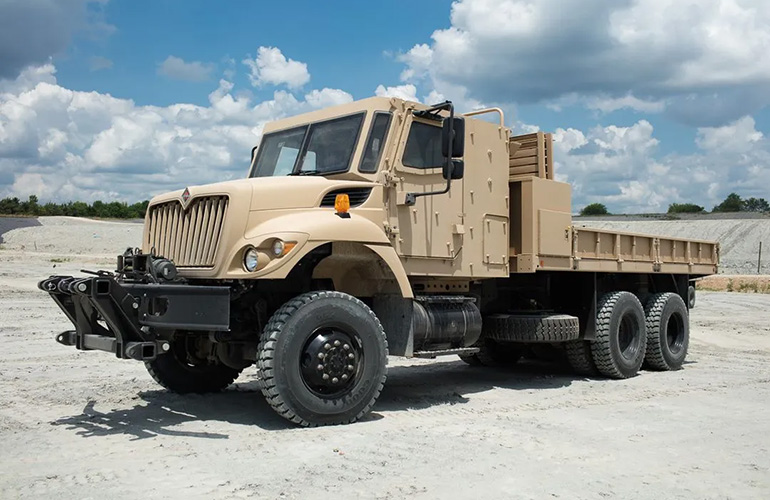
The Armored Cab is designed to meet the evolving needs of troops in theater, providing crew protection on a MILCOTS platform. | Credit: ND Defense
The U.S. Army has awarded an industry team led by Stratom Inc. a Project Sustainment contract to develop the Tactical Autonomous Logistics Utility System, or TALUS, a modular autonomous distribution system designed to resupply dispersed forces in contested environments.
“This announcement is the first public introduction of TALUS,” Mark Gordon, president and CEO of Stratom, told The Robot Report. “TALUS is the name of the integrated capability set our team is advancing under Project Sustainment and our team’s solution for the Army’s Project Sustainment mission. We brought together the TALUS team and its complementary capabilities to address the Army’s requirement for autonomous distribution across contested and distributed operations.”
Founded in 2001, Stratom combines mobility, autonomy, robotic cargo handling, and manipulation technologies to deliver critical materials, cargo, and operational energy. The Boulder, Colo.-based Service-Disabled Veteran-Owned Small Business (SDVOSB) asserted that its systems help improve safety, operational reach, and mission efficiency at the tactical edge.
TALUS is intended to strengthen sustainment resilience
In the future, the U.S. Army said its maneuver formations will require systems capable of autonomous distribution under degraded conditions in contested environments. By reducing soldier exposure to threats and maintaining the flow of supplies, the team said its system will extend operational reach and strengthen sustainment resilience.
Stratom said its team developed TALUS to close logistics gaps between Brigade Support Areas and dispersed forward units. The company explained that multi-mission system integrates proven militarized commercial off-the-shelf technology to accelerate integration and delivery while reducing development risk.
“TALUS will incorporate proven Stratom autonomous logistics and operational solutions, along with the capabilities from the TALUS team partners,” stated Gordon. “Stratom is leading the integration of those technologies into the overall TALUS capability set. We are not able to share specifics about the technologies at this stage, but we expect to provide additional updates as the program progresses.”
TALUS has a modular architecture to support multiple logistics and operational energy missions in multiple domains. It can accommodate varied payloads and evolve as Army requirements change, Stratom said.
“Project Sustainment is an 18-month prototype effort,” Gordon added. “The objective is to integrate and mature the capability and put it into the hands of soldiers for operational evaluation, including the planned Transformation in Contact unit Combat Training Center rotation. The Army will use those evaluations to assess the capability and inform potential next steps toward broader fielding.”
Details
Stratom works with ‘nontraditional’ partners
“The Army needs more than another autonomous vehicle. It needs an integrated logistics capability that can adapt to the mission, operate in contested environments, and move quickly toward fielding,” said Gordon. “TALUS will provide that integrated capability.”
“Stratom brought together this team of nontraditional defense contractors and small businesses because each company contributes a proven, specialized capability,” he said. “Together, we are delivering a practical solution that responds to warfighter requirements and the urgency of the mission.”
The total anticipated project value is $15.9 million, according to Gordon. Stratom’s partners include ND Defense, Forterra, GS Engineering, and Waltonen Engineering. Stratom is leading overall integration and contributing its expertise in robotics and autonomous logistics.
GS Engineering brings model-based systems engineering and testing rigor, while ND Defense provides existing military platforms and production capabilities.
“TALUS brings together the right combination of mobility, autonomy, and systems integration to address a critical Army logistics need,” said Timothy George, ND Defense vice president of sales and marketing. “ND Defense contributes a proven military vehicle foundation and scalable production capability that support a practical path from integration and operational evaluation to future fielding.”
Forterra contributes its government-validated autonomy stack, and Waltonen Engineering provides hardware design, fabrication, and integration expertise. The companies said they will combine specialized expertise, agile execution, and scalable delivery capabilities to provide a fielding-ready solution grounded in established defense and commercial technologies.
“Autonomy for contested logistics must be reliable, adaptable, and ready to perform as mission conditions change,” said Pat Acox, vice president of defense at Forterra. “By integrating AutoDrive with the team’s proven mobility, logistics and engineering capabilities, TALUS will provide the Army with a practical foundation for autonomous distribution even in the most complex environments.”
 Register now and save on your pass to RoboBusiness 2026
The post Strengthening U.S. Army sustainment: TALUS to deliver autonomous distribution appeared first on The Robot Report.
Source
Originally published at www.therobotreport.com.