Unichem acquires Loomia to accelerate entry into the humanoid ‘skin’ market
Automotive suppliers Unichem and R&Y are working with Loomia to develop tactile sensors for automotive and robotics applications. The post Unichem acquires Loomia to accelerate entry into the humanoid ‘skin’ market appeared first on The Robot Report.
Overview
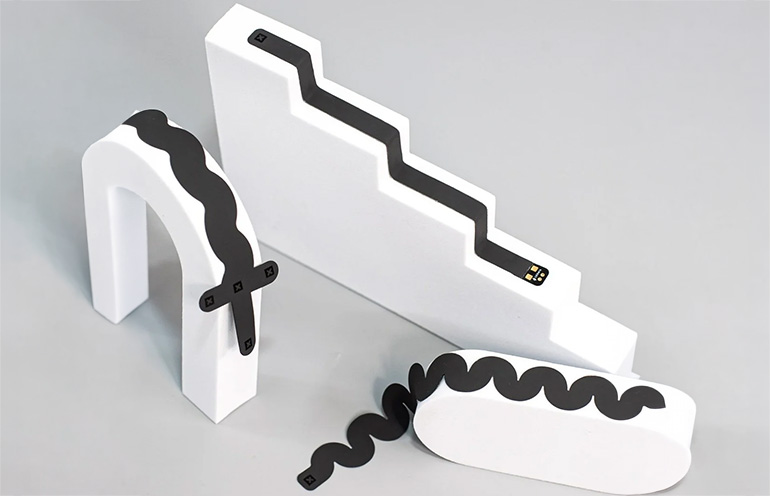
Loomia’s Smart Skin Tactile Sensing Dev Kit includes both capacitive and force-sensitive resistor sensors. Source: Loomia
Sensing “skin” is among the technologies in development around physical AI including humanoid robots. Materials company Uni-Chem Co. this month acquired Loomia Technologies Inc. to enter the market for “electronic skin” for humanoids, as well as the market for interior materials for smart mobility.
Flexible electronics maker Loomia previously partnered with R&Y Corp. to jointly develop and mass-produce next-generation tactile sensors for robots.
“Loomia’s core technology will become the core hardware of the tactile revolution, going beyond just vision to drive innovation in robotics,” stated an executive in charge of strategy at Unichem. “Based on our strong manufacturing foundry partnership with R&Y, we aim to establish a foothold for targeting the North American market and concentrate our company-wide capabilities to ensure that Unichem’s smart materials are incorporated as key components into the next-generation physical AI projects of leading global tech companies.”
Loomia bonds circuits to flexible materials
Stanford University graduate Madison Maxey founded Loomia in 2014. The Brooklyn, N.Y.-based company‘s proprietary LEL (Loomia Electronic Layer) technology allows for flexible bonding of electronic circuits to cloth and leather.
Loomia said it has “overcome the disconnection issue during bending, a drawback of traditional printed electronics, with its non-printed, low-resistance mesh technology.” The company is a member of the National Science Foundation’s (NSF) Human AugmentatioN via Dexterity Engineering Research Center (HAND ERC). The tactile sensing consortium also includes Meta and Amazon Robotics.
Last year, Loomia launched its first tactile sensing developer kit, which is currently sold out. The physical AI company has worked with industrial automation and robotic hand provider Festo. It said it is making tactile sensors more affordable and easier to integrate for robotics developers.
Unichem to conduct a reverse merger
Founded in 1976, Unichem produces natural leather goods for the automotive interior and fashion industries. The Ansan, South Korea-based company said the acquisition will accelerate its shift to smart materials for global automakers such as Volkswagen Group.
Unichem has secured 100% of Loomia’s shares for about 8.6 billion won ($6 million U.S.), which is equivalent to 6.5% of the capital. The transaction amount will be paid in installments with a diversified structure, including $4 million in cash, $1 million in Unichem common stock, and $1 million in earn-out claw-backs.
The company said it expects to complete the acquisition process on Oct. 15 through a reverse triangular merger with a newly established Unichem subsidiary.
Unichem said it plans to integrate 50 years of leather-processing infrastructure with Loomia’s ultra-thin, flexible LEL technology. Maxey and Kim Han-joo, chief science officer of Unichem, will serve as co-CEOs. The companies said they plan to retain all key engineers as part of Unichem’s North American research and development and U.S. market-entry hub.
 Register now and save on your pass to RoboBusiness 2026
R&Y co-develops sensors for haptic systems
Founded in 2022, R&Y is a global Tier 1 automotive technology and manufacturing company with a market capitalization of more than $1 billion and over 2,000 employees worldwide. It has operations in Bösel, Germany; Wixom, Mich.; and Changzhou, China.
Details
R&Y provides co-development, engineering, and production capabilities spanning precision machining, injection molding and tooling, printed electronics, dielectrics, and simulation. Troy, Mich.-based subsidiary of Rying Electronics said it is expanding into humanoid robotics and electronic skin technologies.
Loomia and R&Y are co-developing a product to simultaneously detect both existing vertical pressure and shear force, which is the force that slides on the surface. This technology is essential for haptic gloves for collecting data for robot training and for humanoids that need to handle objects with human-like precision, claimed the companies.
R&Y said it plans to deliver the first engineering sample in January 2027. It is targeting global top-tier robot and AI companies such as Tesla, OpenAI, Boston Dynamics, 1X Technologies, and Meta.
“We believe this collaboration creates a strong foundation for developing and scaling next-generation tactile sensing and electronic skin solutions for humanoid robotics,” stated Harris Wang, head of physical AI and robotics at R&Y. “By combining our complementary technologies and capabilities, we intend to accelerate the path from engineering development to reliable, high-volume commercialization for customers in the rapidly growing physical AI market.”
Loomia and partners to provide smart systems for cars, robots
“With this acquisition as a starting point, Unichem has envisioned a blueprint to move beyond being a simple automotive interior material manufacturer and become a ‘smart materials platform company’ that combines technology and materials,” said Unichem.
It plans to link Loomia’s core technology with R&Y’s manufacturing capabilities and Unichem’s experience processing high-performance materials. “We will expand the technology proven in automobiles to the hands and electronic skins of humanoid robots, medical devices, and data center thermal management fields,” said Unichem.
The company noted that Volkswagen selected Loomia as a supplier of next-generation seat-heating systems for one of its vehicle models through global seat parts company Sabelt. It said this has raised expectations “for an explosive shift to mass production utilizing Unichem’s Korean infrastructure.”
The post Unichem acquires Loomia to accelerate entry into the humanoid ‘skin’ market appeared first on The Robot Report.
Source
Originally published at www.therobotreport.com.
Related Articles
Source: https://www.therobotreport.com/unichem-acquires-loomia-accelerate-entry-humanoid-skin-market/