PartialBiGrasp: Inferring Hidden Local Geometry for Bimanual Grasping from Partial Views
arXiv:2608.19188v1 Announce Type: new Abstract: Dual-arm robotic grasping is essential for manipulating large, heavy, and geometrically complex objects that cannot be reliably handled using a single manipulator. These large objects often contain only sparse graspable regions determined by local geometric properties such as thickness, edge structure, and gripper clearance. Prior bimanual grasping methods assume access to a full point cloud of the object which inherently contains this geometric i
Overview
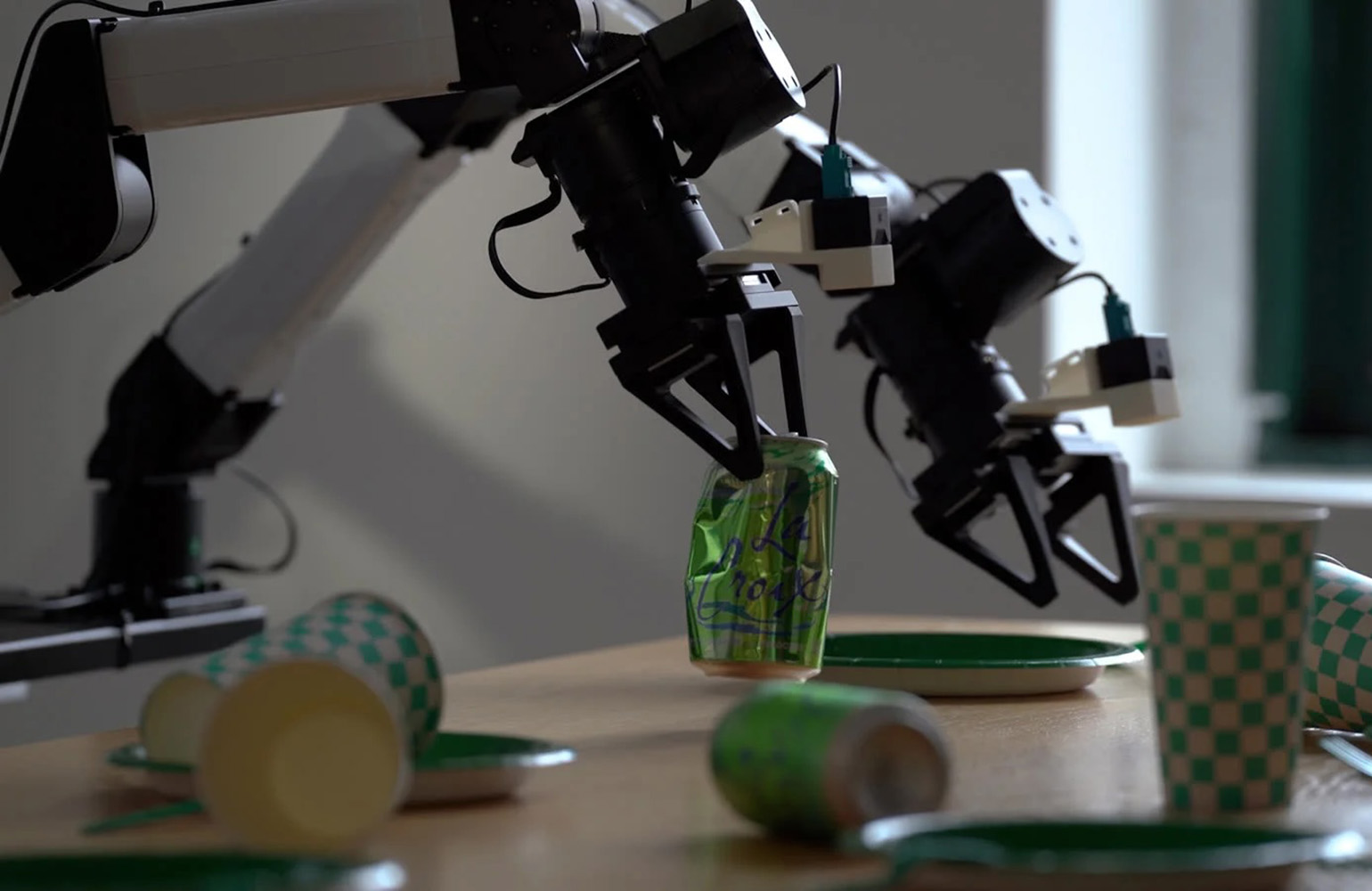
arXiv:2608.19188v1 Announce Type: new Abstract: Dual-arm robotic grasping is essential for manipulating large, heavy, and geometrically complex objects that cannot be reliably handled using a single manipulator. These large objects often contain only sparse graspable regions determined by local geometric properties such as thickness, edge structure, and gripper clearance. Prior bimanual grasping methods assume access to a full point cloud of the object which inherently contains this geometric information, but may not be accessible in real scenarios. This work proposes PartialBiGrasp, a dual-arm grasp generation framework that operates directly on partial point cloud observations. Our model learns geometric features implicitly through convolutional occupancy networks, enabling local reasoning about graspability, collision-free contact regions, and object thickness. We leverage this understanding to generate force-closure compliant grasp pairs, which are further refined using a sampling-based optimization to correct for ambiguity caused by incomplete geometry. We evaluate our approach using analytical force-closure metrics, large-scale simulation experiments, and real-world robot evaluations on noisy partial point clouds of novel objects, demonstrating robust and physically stable dual-arm grasp generation.
Source
Originally published at arxiv.org.
Related Articles
- Scheduling and Routing with Degradation-Triggered Job Arrivals: An Application to Forest Firefighting with an Unmanned Aerial Vehicle Fleet
- GAPL: Grounded Action-effect Policy Learning for LLM-Based Trajectory Planning
- Transferable Tool-Tissue Contact Detection from Stereo Depth in Robot-Assisted Surgery
Source: https://arxiv.org/abs/2608.19188